

About
We built the Go Kit because the classroom was the problem
CPR Certification Labs certifies teams the way organizations actually run — around shifts, ratios and coverage, instead of around a room that has to be booked and filled.
The certification was never the hard part
Every employer who has to keep a team certified runs into the same arithmetic. The course fee is small. The day it costs you is not.
A traditional class asks for one instructor, one room, one date, and everyone present at the same time. For a nursing unit, a job site, a childcare centre or a restaurant, that day is the expensive part — backfilled shifts, overtime, or running short while your people sit in a classroom.
So certifications slip. They get caught during a survey, an audit or a licensing visit, and then they get fixed under pressure and at a premium.
We built the Go Kit to remove the day, not the training.
What the Go Kit actually is
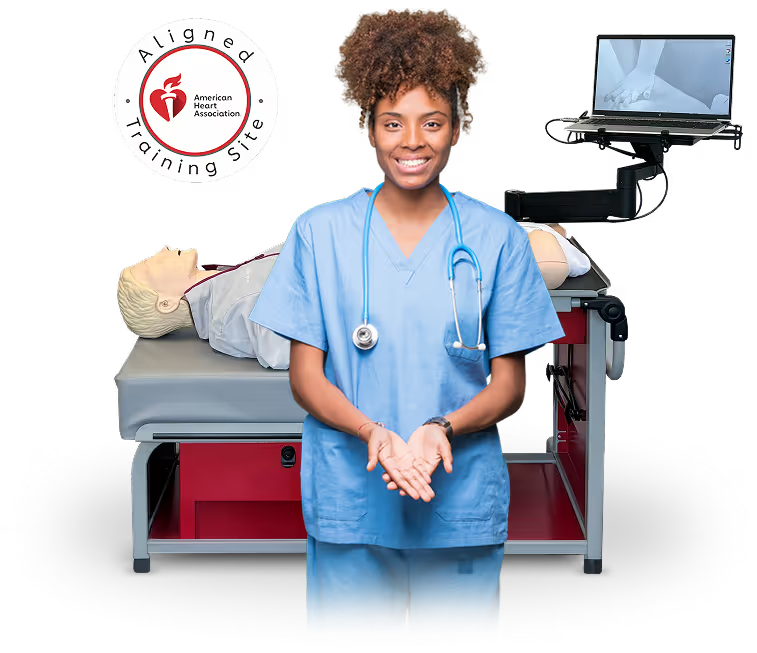
A wheeled case that opens into a complete skills station — an adult manikin, an infant manikin, bag-valve masks, and a tablet running live compression-rate and depth feedback. It runs entirely off its own equipment.
It sets up on a conference table, a break-room floor, a site trailer, a studio mat or the corner of a unit. We bring it to you, so the part of certification that genuinely has to happen in person happens where your team already is.
The coursework — official AHA-aligned material — is completed individually online, between shifts. The Go Kit handles the rest.
Skills are measured, not eyeballed
This is the part most people don't ask about until they've seen it.
In a conventional class, “you passed” is one instructor's judgment of a room full of people. On the Go Kit, compression rate and depth are measured live on the tablet while the person works, using RQI technology. They see their own numbers. So do we.
That matters for two reasons. Compressions that are too shallow or too fast are the most common failure in real resuscitation, and they're invisible to the naked eye. And a measured check-off is a defensible record — not “we ran a class in March”, but a per-person result.
Two ways to reach your people
Most training providers have one delivery model. We have two, and the second is what makes the first work.
We come to you. The Go Kit goes to your site for teams certifying together.
Or your people come to us. 72 CPR Certification Labs locations across Texas, Ohio, Oklahoma and South Dakota, and a license pack is redeemable at any of them.
That second mode is the one employers underestimate. It covers the people who missed the on-site session, the new hire who starts in October, the home health aide who is never in the building, and the team too small to justify a visit. Coverage stops depending on everyone being in one place on one day.
What your people walk away with
A nationally recognized American Heart Association eCard, issued to the individual, in their own name, verifiable online by you or by a surveyor.
It's issued as soon as they pass — the same day. For context, the AHA requires Training Centers to issue completion cards within 20 business days. Most providers use most of them.
The card belongs to the person, not to the employer who paid for it, and it stays valid for two years — through the end of the month it was issued in.
Tell us how many people are due, and when.
Send us your renewal list — even a rough one — and we'll come back with a plan, a price and a date.